Why a Packed Bag Shifts When You Walk
Why a packed bag shifts while you walk comes down to weight and movement. Learn how to group loose items and settle the load close to your back.

Why does a packed bag shift when you walk, even on an easy path? Often, the cause is not the bag itself but the way its contents move: a bottle rolls, a jacket slumps, or a dense object swings away from your back. A few deliberate choices can make the load feel steadier without turning a relaxed outing into a packing project.
Movement reveals gaps inside the bag
A bag changes shape with every step. If objects have room to slide, each one can move on its own, pulling the fabric and changing how the load rests against your shoulders. The effect may feel like a gentle sway at first, then become a repeated tug that draws your attention away from the walk.
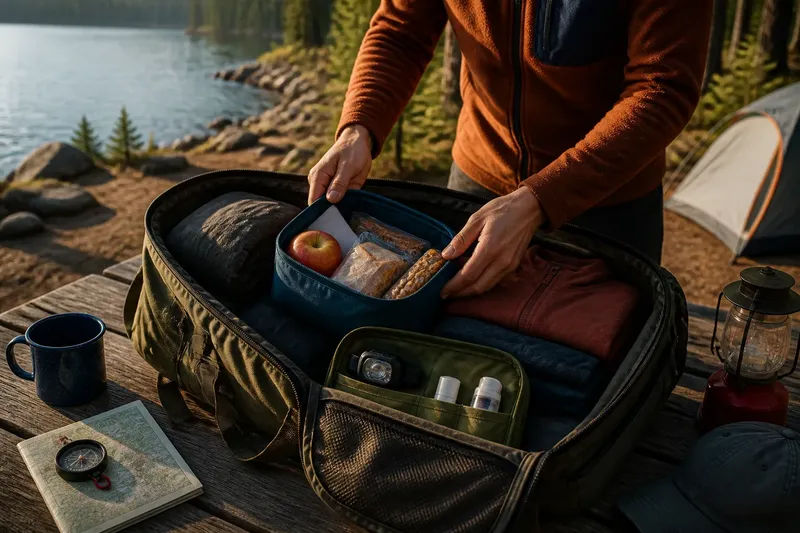
Think of the contents as books on a shelf. A row held closely together stays put more easily than the same books scattered with empty space between them. In a pack, soft items can fill some of those gaps, while small belongings can be grouped so they do not scatter through the main compartment.
Pay attention to when the movement occurs. If it starts when you turn, loose objects may be shifting sideways. If the bag pulls backward with each stride, a heavy item may sit too far from your back. If you hear a rattle, hard objects may be knocking against each other or the bag frame.
Keep dense items close to your back
Items such as a full water bottle, a compact food container, or a small camera carry more weight in less space than a fleece layer. Place these denser pieces close to the panel that rests against your back, rather than out near the bag’s front. This keeps the load from feeling as though it is hanging away from you.
For a casual day walk, that might mean keeping a bottle in an interior sleeve or in a pocket against the back panel, if the bag has one. A soft layer can sit farther out, where it also helps occupy space. Keep items you reach for often accessible, but avoid letting convenience put every heavy object in an outer pocket.
Balance matters from side to side, too. A heavy bottle on one edge and a similarly dense object on the other can feel more even than concentrating weight on one side. Do not add an unnecessary item just to create symmetry; instead, shift belongings you already need.
Group small items and contain soft layers
A charging cable, snack wrapper, keys, and folded bandana can migrate to the bottom of a bag if they each have an open path. Put small items with a shared purpose in a pouch or a zippered pocket. For example, keep keys and a wallet together, and keep a cable with the device it serves. Grouping limits the number of separate objects that can wander.
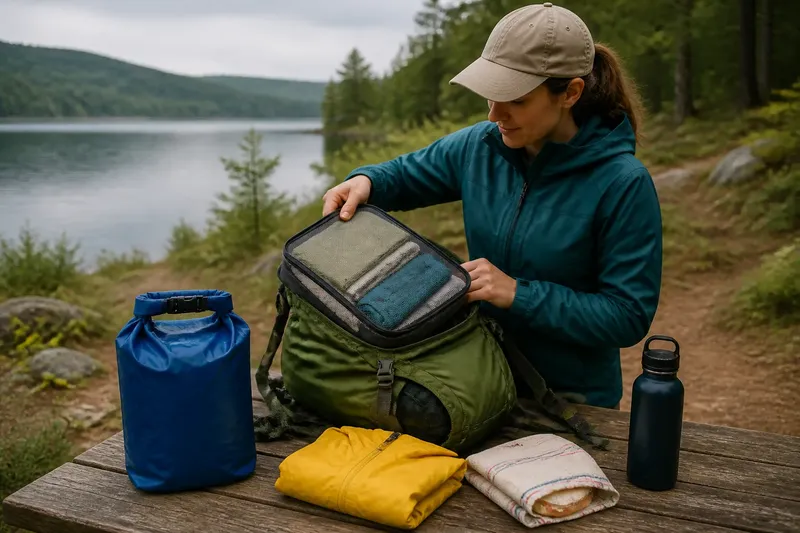
Soft layers can also change position as the bag tilts. Fold a jacket or fleece into a broad, manageable shape and use it to fill a gap beside or above the denser items. It should cushion the contents, not be jammed in so tightly that the bag becomes difficult to close or something becomes hard to retrieve.
Imagine you are packing a light day bag for a park walk, with a water bottle, lunch box, fleece, keys, and a small notebook. Say the bottle is sitting at the far front and the keys are loose near the bottom. Move the bottle near the back panel, put the keys in a zipped pocket, and fold the fleece into the open space around the lunch box. The expected observable result is less clatter and a bag that stays closer to your body as you turn.
Check the load with a short walk
A quick check before leaving can reveal a packing problem while it is easy to fix. Close the bag, lift it by its handle, and notice whether one side hangs lower. Put it on, adjust the shoulder straps to a comfortable fit, and walk a few paces. The goal is not a rigid, immovable load; it is a bag that does not repeatedly swing or pull at each step.
- Listen for rattles. If hard items knock together, separate them with a soft layer or keep them in a small pouch.
- Notice backward pull. If the bag seems to tip away from you, bring dense items closer to the back panel.
- Check side-to-side balance. If one shoulder bears more tug, rearrange the contents rather than adding weight elsewhere.
- Look for a sagging base. If small items have collected below the main load, give them a pocket or pouch.
- Test access. If retrieving a snack requires unpacking everything, move it to a suitable outer pocket without placing heavy objects there by default.
Make one change at a time and walk again. That makes it easier to tell which adjustment helped. A bag that feels settled on flat ground may move differently on a sloping path, so take the same easy pace you expect to use and notice whether the load still shifts.
Why does a bag sway more on turns?
Turning changes the direction of your movement, while loose contents keep their momentum briefly and press against the bag. A bottle near the outer edge can make that motion more noticeable, so move dense items inward and keep small objects contained.
Should a heavy item go at the bottom of a bag?
Not automatically. If a dense object sits low and far from your back, it may pull the bag downward and outward; place it close to your back panel and arrange softer items around it without blocking anything you need.
How can I stop small objects from moving around?
Use an existing zippered pocket or a compact pouch for related items, such as keys and a wallet. This keeps them together and reduces both rummaging and the small rattles they can make against harder belongings.
When should I repack instead of tightening the straps?
If the bag still rocks, pulls backward, or feels uneven after you adjust its fit, change where the contents sit. Straps help the bag rest against your body, but they cannot prevent a loose, poorly placed load from moving inside it.
For a more settled walk, start with the simple principle behind why a packed bag shifts: anything heavy or free to move can tug the bag as you travel. Keep dense pieces close to your back, give small belongings a place, and use soft layers to fill spare space. A few steps after packing can tell you whether those changes suit your bag and the day ahead.