A Leave-Ready Camp at the End of the Day
A leave-ready camp routine helps you gather small belongings, check the ground and restore your immediate area before heading home or onward.
What should you check before leaving camp so that a useful little item or a scrap of litter does not stay behind? A leave-ready camp routine works best as a calm sweep of your own immediate area, not as a hurried search after everything is packed. Choose a sequence that fits the site, then use it consistently.
Choose a routine that fits your departure
There are three sensible ways to make a final check: gather and inspect as you pack, pack first and sweep afterward, or assign each person a small zone. Each approach can work. The right choice depends on how many people are leaving, how much personal kit is spread out and whether the campsite has boundaries or shared features that should not be disturbed.
Gathering as you pack suits a solo camper or a small, orderly setup. Pick up each personal item and return it to its place as you put your bag together. This keeps the ground clear while you work, but it can be easy to overlook a small object if you pack in a rush or have been moving between tasks.
Packing first and sweeping afterward suits someone who prefers to see the whole area at once. Once your belongings are packed, scan the cleared space for items and scraps. This gives you a more open view of the ground, though it requires a deliberate final pause; do not treat the last look as optional just because the bag is closed.
Dividing the area suits a group. Give each person a clearly bounded patch, or let each person check the space where they spent time. This reduces overlap and makes responsibility visible. It is less suitable when boundaries are unclear, so agree on who checks shared spots such as the place where everyone sat.
Gather personal kit before checking the ground
Start with belongings that have an obvious owner: clothing, a water bottle, a mug, a book, a headlamp, a phone, a map, and any small pouch or case you brought. Check the places where you used them, rather than relying on memory alone. A jacket may have been set aside near a seat, while a phone might be resting beside a map rather than inside a pocket.
Then check temporary resting places: the top of a pack, a flat rock used for setting down a cup, a bench, or the ground beside where you sat. Pick up only your own things and leave natural features as they were. If something belongs to another camper, ask before moving it when that is practical.
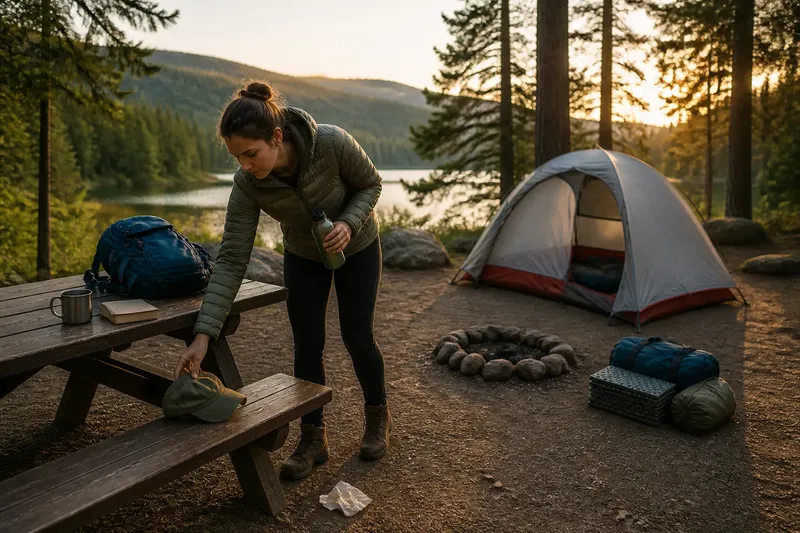
Imagine you are packing after reading beside a picnic table. You put your book and bottle away, then look at the table and the ground where you had been sitting. You notice your hat on the bench, retrieve it, and see a paper wrapper nearby; if it is yours, you take it with you. The observable result is that your belongings are accounted for and your small use area is clear, without extending the sweep into someone else’s space.
Look for small items and scraps in likely places
Small objects are easiest to miss when they blend into the surface or sit near other gear. Make a slow visual pass at normal standing height, then glance down around the places where you handled food, changed layers, or opened a bag. Look for a dropped cap, a twist tie, a tissue, a corner of packaging, or a loose utensil. Do not rake, dig, or pull apart vegetation to search for an item.
Check edges and transitions: beside a seat, near the path you used to reach your spot, and around the place where you set down a pack. These are useful areas to scan because people often pause there to adjust belongings. Keep the check within the area you used; a departure sweep is not permission to roam through a larger site or disturb another party.
Handle litter according to the site’s disposal setup. Put your own waste in the appropriate receptacle or carry it out if no suitable bin is provided. If you find unfamiliar litter, use common sense about whether it can be picked up safely; leave hazardous or uncertain material alone and alert site staff when appropriate. Follow posted directions for waste and shared facilities.
Restore the immediate area without overworking it
Once your belongings and litter are gathered, look at the ground and nearby shared surfaces. Return moved portable items to where you found them if they belong to the site and can be handled easily. Brush loose crumbs from a table only as the site allows, and avoid shifting rocks, branches, or other natural material to make the spot look groomed. The aim is to leave the place in its ordinary condition, not to improve or redesign it.
Think of the final sweep like putting a borrowed chair back beneath a table: restore what you moved, but do not rearrange the room. At a campsite, that means keeping your actions limited to your own use and to simple, appropriate tidying. Site rules, posted signs, and staff directions take precedence, especially around shared equipment and designated areas.
Do not try to erase normal signs of being present if doing so would disturb the ground or plants. Instead, gather what you brought, remove your waste, and leave natural features alone. If a site provides a specific process for departure, use that rather than improvising a different cleanup routine.
Which departure approach fits your camp?
Should I check while I pack or after?
Check while packing if your setup is small and you can return each item directly to its place. Add a separate final glance afterward, since packing can draw attention away from the ground.
How can a group avoid checking the same area twice?
Agree on simple zones, such as each person’s seating area and one shared gathering spot. If a zone has no clear owner, name one person to inspect it before anyone leaves.
What should I do with litter I did not bring?
Pick up only what you can handle safely and dispose of it as the site directs. Leave unfamiliar or potentially hazardous material untouched and notify site staff when appropriate.
What if I cannot tell whether a spot is mine to tidy?
Limit your check to places you used and items you recognize as yours. Ask a companion or site staff before moving property or changing a shared area.
Make the last check easy to repeat
Use one short verbal cue as you leave: “my things, small scraps, my area.” It is not a substitute for looking; it simply reminds you what to look for. The phrase can be said quietly while you scan, so it works whether you are alone or leaving with a group.
A leave-ready camp does not require a long ritual. Gather personal belongings, inspect the likely places where small items settle, and restore only the immediate area you used. That simple routine leaves you with a clearer departure and gives the next visitor a site that has not been needlessly altered.